A primary source is a document that existed at the time period with which one is studying. A painting of the 1850s drawn in the 1850s is an example of a a primary source. Primary sources are the most reliable way we can learn about a time period. A primary source is one that has not been contaminated by modern opinion. We get a clear picture of how life was during that time period. If one reads the journal of say, Julius Caesar's conquest of Gaul, we get an idea exactly what occurred and how it happened. Primary sources give one an exact idea of what happened. Through a primary source we also gain introspective into how a person in that time period thought and since our thoughts have changed since then we gain knowledge of the thoughts of people of that time.
Museum

This poster is one of many advertising
Buffalo Bill's Wild West Show. This show highlighted "wild west" attractions from rifle shooting tricks to band music popular in saloons. This poster also shows another popular aspect of the show, its riders on horseback performing tricks that the cowboys knew. Indians were also added into the show and their culture showcased as well. This shows how the United States conquered the west and life during the New Imperialism was affected by many new trades and exports coming out of the Western United States. One of those exports was the stories of the cowboys and Indians. The United States gained more power and more land when it pushed natives out of their lands and sent more settlers into the wild west. This poster helps show how western culture had spread, even to the broad expanse of the western United States. This source for this picture is a credible one. It comes from the
Buffalo Bill Historical Center in Cody, WY. I myself have been to this museum twice in my personal travels and actually remember seeing this and other posters. The museum has many collections from Plains Indians to a firearm section.
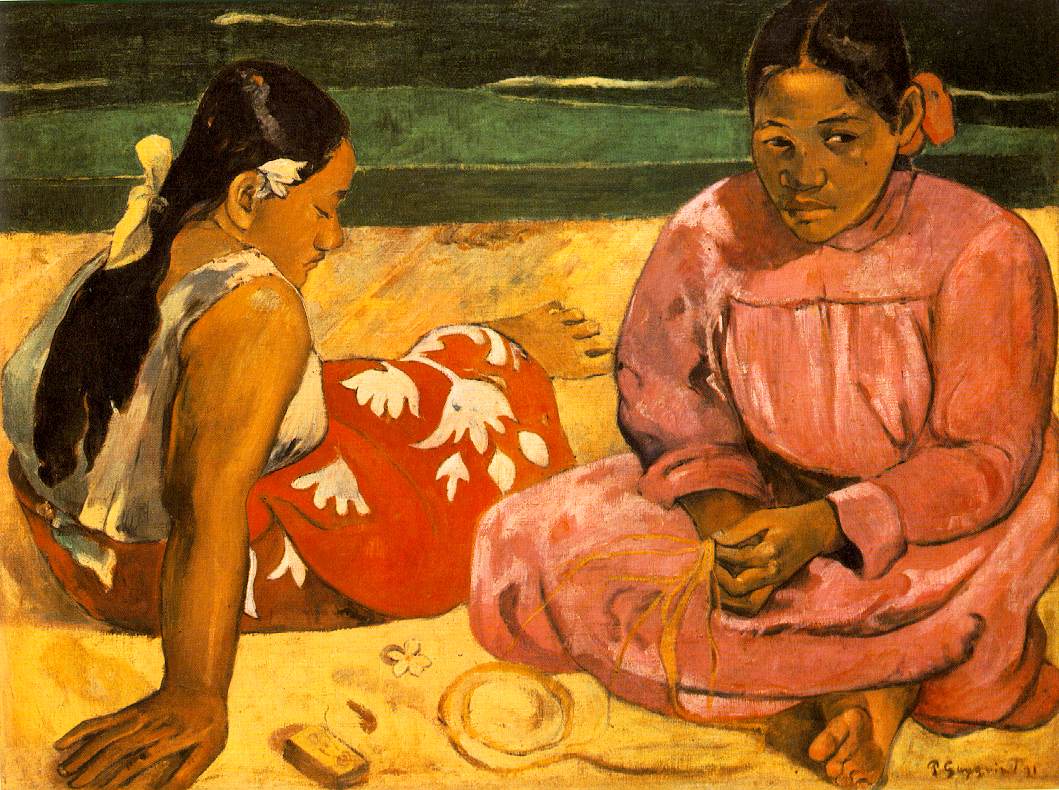
Femmes de Tahiti by Paul Gaugin
This is a painting by the Post-Impressionist Paul Gaugin. It is of two Tahitian women on a beach. Paul Gaugin was a painter who was once the head of the Postimpressionistic movement in France, but the movement of Postimpressionism was unpopular with the bourgeois and he decided to go Tahiti. Paul considered the land a place of unspoiled beauty and he painted a series of paintings there. This is an excellent example of how the New Imperialism effected life. Before the western powers felt the urge to conquer and explore the globe, places like Tahiti were far off the beaten track and hardly any Westerners had travelled to these places. They had not travelled there because there was no type of civilization that they were familiar with. France owned Tahiti in the very early 1900s and therefore Frenchmen, like Gaugin, could visit and explore the beauty of those foreign cultures. The source is reliable as it is a webmuseum of Paris and showcases many works by French and other painters.

This is a picture of the officers of the Rattrays Sikh. Rattrays refers to soldiers and Sikh is a religion which is mostly centered in the Punjab region of India. These were the officers who led a battalion commissioned by the British Indian government to police an area in the Lower Providences of Bengal that was currently revolting. The battalion is still very much in existence today and serves the Indian government. This picture depicts the members in their dress uniform, which in and of itself is an example of the New Imperialism. Britain conquered India and made it a colony called the British Raj (governing power of India or the actual name of the British occupied country). Life in India was radically changed with new British ideas flowing into the country. Efforts to modernize, throw off former systems of government, and embrace new technologies dominated how Indians thought. India as a country started to get nationalistic thoughts during this British occupation and eventually led to Gandhi and the formation of modern India. On the flip side, Britain gained many things Indian from their occupation. Britain received more exposure to tea (such a characteristic of British culture today!), curry, spices, cotton, and silk. The British Empire loved its Indian providence for its natural resources and human manpower, and trade between the two nations led to globalization for the entire region of southeast Asia. the source is from a site about the regiment's history and has many pictures of the regiment through its long existence.
 This is a picture of Winston Churchill examining a Lee-Enfield rifle.
The artifact I have chosen is the famous Lee-Enfield rifle. The gun was developed in 1888 and is considered to be one of the most famous guns ever made.
The Enfield was an incredibly reliable gun and the British army used it during both World Wars and prior to those engagements. The gun uses a "cock-on-closing" bolt and has the capacity for ten rounds in its magazine. The gun had quick firing capabilities and a fairly large magazine compared to muzzle loader or single shot breech firing gun of the time. The British certainly took advantage of superior weaponry at the time with all of its army's soldiers carrying this gun. The New Imperialism was directly impacted by developments of weaponry, like the Lee-Enfield rifle since this allowed the British to take advantage of superior weaponry. No native would have access to high technology like a multiple round firing weapon. This gun helped the normal foot soldier fight his way to British power. powerful weapons like the Maxim gun were also developed but they helped regiments as a whole and not the individual foot soldier. To a normal man, a better gun could be a godsend in many a dire situations. The gun also stood the test of time and was so advanced for the 1880s that it stayed in use by the British military until 1957. The picture is from the show "How Stuff Works" and the information from a
website of Lee-Enfield enthusiasts.


No comments:
Post a Comment