Tuesday, August 31, 2010

The Great Awakening and the Separation of Church and State

The Great Awakening was a religious revival movement that cropped up in American history in around 1734. It was a revival of the old ways of thinking about religion. It started in Northampton, Massachusetts by John Edwards, a fiery preacher. These preachers felt the Church was becoming too liberal in its acceptance of people and its general principals. These firebrands of religious ideals felt the whole system was soft and the ignited a fire of religious fervor by their own crazy talk of how people were going to be damned to hell forever unless they repented. The main reason all this insane speeches of eternal damnation caught on was because they simply accepted the meetings as a form of entertainment and something to do. The meetings were notoriously flamboyant and places of deep, deep emotions. After Edwards, George Whitefield led the Great Awakening to new popularity and brought even more spirit and life into the religious life of the colonies. All in all, the Great Awakening brought tones of spiritual life into the colonies.
The question on hand is how the Great Awakening triggered the separation of Church and State. In my opinion, the colonists felt that religion was too good to be spoiled by the problems and general nastiness of political dogma and problems. They were already taking steps towards such a separation by saying that no preacher could become a member of the town council or hold political office. These colonists were caring for their precious, holy of holy religions and not letting it become corrupted. By corrupted, I mean that the authenticity of their spiritual devotedness would become soiled by worldly matters. No true God loving Christian would want this to happen. Religious matters should not become a bureaucracy. This is the rules of God, not your own interpretations of them. Finally, real religious faith would not interfere with politics to get people to believe in their faith. That is not faith at all and proves further that religious interferences in politics would only ruin the authenticity of any religious endeavour.
Our modern government has a clear separation of church and state. Sometimes the argument crops up that the government should allow religious prayers and values into the system. That argument would surely not be agreed upon by a colonist who lived in the Great Awakening since they would see this as promoting the lack of authenticity in their religion. Plus, this type of worship is not personal and deeply meaningful, it is fake and forced. Modern politics are too vastly ever changing to be confined to one religious dogma and due to their dynamic attitude any religious interference would really not work well.

Wednesday, August 11, 2010

Wednesday, July 14, 2010

AP US Mayflower Reading Questions

1. The Pilgrims were very devout and in some respects hardheaded people. Their incredible faith in God's will was unrelenting to every aspect of their life. Whether they determined that every single death was simply "the providence of God" or believing they had the right to take away Native American corn and beans when they were hungry. I believe that every trait that enabled the pilgrims to survive in America also was a hindrance or limited them in some way, shape or form. The pilgrims were already outcasts from England when they went to Leiden, Holland. This seems to have gotten them ready to become outcasts from the whole of Europe and everything they were familiar with. The outcast attitude of the pilgrims did not help their Indian relations any. At first the pilgrims believed the Indians savage and were hostile towards them. Their attitude of "leave me alone" at first led to suffering and a very hard first winter in America. The Pilgrims other dominant characteristic was the unwavering faith in their God and their belief that all things happened according to his will. This obviously helped them survive and persevere in the face of so much death during their first winter. Their faith might of been a inconvenience sometimes. The Pilgrims demanded Sunday be a day of rest. Work could not be completed on this day and therefore in times of need (like when they desperately needed a fort built for fear of attack) their faith proved to be annoying.

3. Who doesn't like the thought of a little gluttony and indulgence in a faked up name of a holiday? I believe (as obviously stated by so many other people) that Thanksgiving in just another reason to blow money and feed our money crazed capitalist economy. Perhaps I may be an absolute prick but really America? Do we need another reason to blow our money? Are gas sucking SUVs and new 3D TVs not enough?? Plus, do Americans really need another reason to eat more than enough? How about in the spirit of the Pilgrims, we all go out to a farm and work all day or go hunt in the forest with primitive weapons? Maybe we could actually burn off some of the massive amount of useless calories we consume all in the name of an imaginary feast of our forefathers. Thanksgiving, I believe, is the most annoying fictionalized fact about the pilgrims. The whole Plymouth Rock mix up and scam is simply irksome. The whole ordeal is just proof that We like a very Romantic view of the Pilgrims and simply don't want to change that view. America has forsaken the truth for one reason and that is because the truth is just too ugly and we prefer to bend it to give ourselves some pleasure and make it seem that the Pilgrims were all sweet little angels.
4. In the 1670s New England colonies were expanding with the addition of many new Puritan settlers in Boston and many other towns around the area of Cape Cod. These Settlers wanted farms and a place they could call their own where they could carve out their fortunes as they see fit. Unfortunately this obviously required land and the Puritans were desperate for it. They started encroaching on Indian lands. The Indians had run out of trading goods and were resorting to trading land for English goods. Massasoit had now died and his son Metacom took over. He was not as good as a leader and not so eager to maintain the peace his father had worked for. The Indians started becoming aggressive again and were egged on by religious issues and trade problems as well. I believe if Metacom had been a better leader ready to accept change the conflict known as King Philip's War could have been avoided. The Pilgrims too had a large part to play in the conflict. They technically started the fighting but the Pilgrims too were becoming to stiff-necked in their views of the Indians and their desire for what the Indians had.
5. Squanto was quite the Machiavelli of the Indian world. He brilliantly tried to play off Massasoit and the Pilgrims to give himself some power. Squanto spoke English since he had spent time in England after being captured by the Englishman Thomas Hunt. Squanto was quite admirable to the Pilgrims since he helped them plant maize and get them through their first winter in the New World. Squanto was also a scout for the English. He shaped history by his actions as acting as a diplomat between the Pilgrims and the Indians and to his credit he helped gain important alliances between formerly hostile Indians and the Pilgrims. He certainly helped the Pilgrims gain a foothold in America and showed that alliances between the Indians and English were possible. Unfortunately the power he wielded between English and Indian corrupted him and he tried to play the English off against the Indians in an attempt for him to gain personal power that he had lost. He made a huge difference because , like i mentioned before, he provided himself as an outlet between Indians and Pilgrims.
8. What we today fail to realize is that the Natives in the Americas were not just a couple of ragtag villages hobbled together. These Indians were massive nations of thousands of people large all living in a society together. Perhaps we have come to see all Native Americans as one type of person but as the book reminded me, these people were all very different just as a New Yorker is different than a Southerner or a Surfer-dude from SoCal. Hollywood so often shows them as masses of unorganized primitive rabble but when in fact they had beautiful, varied cultures. I believe the book was making us see that these individual nations of people were really like those nations of Europe; independent, powerful, and culturally unique. Some popular images of Indians are still present, however. The Indians,as illustrated in the book, took grate pride in many of their cultural celebrations (ghostdances, etc...) that we have come to expect a Native to do. The Natives also lived in wigwams and they dressed in clothing that I would picture as "Native American." Their general behavior towards the pilgrims was also what was expected. At first hostility and then gradual trust. The Natives also waged war against the settlers and performed acts (such as scalping) that i imagined they would.
9. King Philip's War was certainly a bloody affair and not many heroes emerged from the bloody fray simply because leaders on both sides, frankly, made complete asses of themselves. Perhaps only one man can be rightly labeled as a quote on quote "hero." That man was Benjamin Church. The man simply had some common sense! Obviously traditional ways of battle were not going to work in the cramped quarters of the forests and bogs of New England and only Church had the sense enough to realize it! He commanded a garrison free of the governor's command and had the brains enough to employ the use of enlisted Natives to help him.
10. The English certainly had trouble seeing the Indians as all unique groups of people and no one singular group of people. Every tribe had its own practices, language, and way of living life in general. The English, however, perceived the whole people of America as one great race not the individual tribes that they were. This misconception only raised the problems that started King Philip's War and fueled it to more complex levels. Indeed, the War probably would have been over quicker if the English had the sense to enlist some of those Indians who were not pleased with King Philip's decisions to go to war against the English who they had come to trust and, more importantly, trade with. Certain tribes like the Narransetts who were on the fence about whether or not to go to war were forced into conflict by English aggression against them and English attacks. All in all, if the English realized earlier that each tribe of Indian was entirely different with unique wants, the war would not have lasted as long.
11. Those Indians who sided with the English were not being treacherous. These Indians were being sensible. As previously discussed, every tribe was a different entity entirely and therefore each tribe had different policies. Some of these policies were more carefully planned than others. The idea had occurred to some Indians that English guns, goods, and alliances were much more important than a few petty misunderstandings and jealousies. Maybe these Indians who sided with the English saw how well the "Praying Indians" were treated and realized it could be them too who were to get additional aid. These Indians were being opportunistic as well as sensible. They had a lot to gain in the way of weapons and alliances. They also had the sense to realize that the English were not going anywhere anytime soon and it might be best to support them in their efforts against Philip, who was already unpopular. If I was an Indian I certainly would pledge myself to the English cause. It is a very logical decision since the English would have More to offer me and besides, I'm in this war for myself. If I was an Indian I could look to the English weapon supremacy and be impressed and also see their goods as very desirable.

12. War is a brutal pursuit for both sides concerned. Even soldiers will tell you that in war, there are no winners, only those who live and those who do not. I believe the same applies to King Philip's war. No side can claim that their cause was more just or morally superior than the other. Such a claim is obviously contradictory to the fact that war results when two countries can not work with each other through diplomatic means. The Indians in the war were very brutal towards the English and certainly were not morally sound in their scalping. The English were no better. They drew and quartered Philip and other Indians as well plus were simply unpleasant to the Indians on many of their meetings. As mentioned in the question, there are accounts of both sides taking body parts as gruesome souvenirs. On the positive side, Indians saved Mary Rowlandson and kept her in fairly decent shape. The English too extended courtesy to those "Praying Indians," however they were not so nice to the captives they packed up and sent to become slaves. All in all, neither side can claim their cause more morally just than the other do to the amount of brutal acts committed on both sides.
15. I disagree with the statement by the critic of Philbrick. Philbrick did avoid pointing out any moral lessons. He made clear the problems the English showed with their animosity towards the Indians and how these problems damaged relations and heightened war between the two cultures. The main moral lesson Philbrick wanted the readers to learn was to learn to accept other people's differences and more importantly to realize how groups of people can be very different from each other. The English viewed all Natives as the same and to this end they were gravely mistaken. In our lives we sometimes stereotype people into categories by where they live and judge the individual by the group he or she is surrounded by. That thinking, as demonstrated in history, can be quite deadly and cause great conflict. The largest moral problem in the book was really the cultural clash between the Indians and the English that was always a problem for the two people. Whether or not to cooperate was always a pressing issue in early America.

Monday, June 14, 2010

AP US Music Project

Track #1
The recording artist for this first particular track was looking to show the spiritual devoutness that was common in the European world at the time. Music during the middle ages and into the renaissance and age of exploration was still very focused on the Church and often many facets of life were centered around the Church. This track is a reminder how the first American settlers were truly and purely European in their origins. They carried over their music to the New World and certainly the Pilgrims and Jamestown settlers all still sung in hymns like this. These voices show how starkly different the way of life for Europeans was compared to that of the Native Americans like the Iroquois or Apache.
Track #2
Drums were much more than an instrument in the Native American way of life, they were integral to life of any ceremony. Each tribe in every area of the United States has their own type of drum and how they play it can differ drastically. This type of music reminds one of the simplicity and beauty of native music. Just a beat, a little soul, and a drum and one has music. The recording artist wanted to show that life before Europeans was just as vivid and rich in culture as it was later once they arrived. This music highlights the time when life was more simple and natural for the Indians and this type of music is an example of music from the many hundreds of years the Natives lived in America and the history they had before any other foreign influences came in.
Track #3
Another really cool tribal track here for #3. The point to me of this piece was to illustrate the Native American ability to play instruments as good as the Europeans. This start is soothing and again is a reminder of the days before the expansion of the European world into this wilderness. Pieces like this remind one of a bird in the woods, or an owl at night. All things were much simpler in the US before the foreigners came to these shores. This piece illustrates a time in history where an instrument could surpass all other forms of entertainment with its elegant beauty and distinct sounds. This simple song and simple instrument served as an influence to future settlers and this voice helped to show the new Americans what was truly in the New World, a wonderful spirit of people.
Track #4
This piece was recorded recently and i have heard of Mark O'Connor and his folk fiddle music skills but i certainly enjoyed this duet with the great Wynton Marsalis. The piece has no lyrics but i believe it is about the General Wolfe who died fighting the French in Canada. At least that is what my research suggests. The piece is quite beautiful and i believe it is a musical example of the blending of styles. One can hear overtones of Native American music in the piece and it can be classified as being "folk" music. Mark O'Connor is providing a historical outlet to the past by illustrating the wonderful music that can be created using the simple melodies of the early Americans.
Track #5
This song dates from the Revolutionary war period and has quite a simple message. It laments the fact that a soldier has gone and sold his former tools of trade for weapons of war like the sword. The woman too cries over her loss and will now beg in the streets for bread and food. This song lets us learn of the first war America ever undertook and the cold, hard facts that surround war. These voices of the past describe that the war against the British was one that effected everyday life and normal people lost loved ones and possessions too. The singer is offering a current view on the events of the war as they are happening. The song clearly shows the first pains of war the American people would face. I was not wild on this version of the song but i very much appreciate the simple lyrics and their clear message. I believe the part about dying the woman's dress red is a powerful image of how the women is going to show the fact that her lover could die at anytime.
Track #6
This very popular song of the time period was written in 1854 and played a role as being quite popular during the Civil War. This song begs people to remember the times when things were not easy or to think about those who are currently suffering. The song speaks of times of funerals and a woman who was once merry but is no more. The song's popularity during the Civil War is not surprising since so many people lost their lives the thoughts of a time where hard times could really come again no more would be a very attractive one. This song speaks of how horrid things were in America at the time. I think the song itself is not a very nice one and certainly would not do much to lighten one's mood on an occasion, but it does have another strong message about war and how we should remember the hard times even if those hard times are about anything.
Track #7
This song is about an Irishman's journey to America. After some research I have found this song is actually about the Civil War and this particular Irishman is fighting in the war even though he is not American. The Irishman has lost a lot in Ireland but is forced to go to America by hunger and other factors. This Irishman was one of thousands that would come to America for work and other circumstances. This is a very enjoyable Irish tune and has strong historical overtones as well. The song is from the actual view of someone in the midst of the immigration to America.The Irish diaspora was one of the largest immigrations by foreigners into America. The Irish can be seen as early immigrants just as Central Americans are today. I believe the story of an immigrant should be seen from the immigrant's eyes and the pain the experience should be realized by the host nation. This song speaks much of America's history in the ways in which we treated immigrants.
Track #8 Jesus Christ
Date: 1940 (?)
The song, in a nutshell, describes Jesus Christ's attempts to get the rich to give to the poor. Woody Guthrie was a man who was committed to change and was considered one of the first, so dubbed, "protest singers" In the song "Jesus Christ" he is showing how Jesus was killed by people who would not be parted with their money. The song is sending a message of anti-capitalism through the depictions of Christ's death by bankers and others. Woody also points out that if Christ were to go to New York he would be killed there too, despite the fact that people there already know of Christ's actions. The message is clear, America's drive for more power and money was creating poverty and extreme wealth which are still problems today.The image of a lone migrant worker is a powerful one in my mind and Woody Guthrie's soulful voice and ancient guitar plucking is sacred ground. I believe that he was one of the last great Folk musicians ever, only rivaled by those great bluesmen who came out of the south. Woody was an Anglo version,in some ways of the great, Robert Johnson. I thoroughly enjoy Woody and own many of his recordings and appreciate the awareness he brought to those poor workers during the late 30s and 40s.
Track #9 Do Re Mi
To begin with, I absolutely despised this version of the great song "Do Re Mi" by Woody. The song is about one of Woody's most popular topics, Dust Bowl migrants. The song says, put basically, that migrants should stay right where they are whether it is Texas, Georgia, Oklahoma, or Tennessee. Too many of these immigrants entered California looking for work which, frankly, did not exist. The term "do re mi" refers to money. Woody is implying that with our money it is not possible to make a living in California. This term is very useful since it is a musical term referring to the first three notes of any major lonian scale. I believe Woody is using the term to indicate how these migrant workers often sung songs and by using a musical term for money is indicating that they wished their talents (such as music) could somehow be used to make a living in the harshness of the time period. Again, the version on the CD was terrible. I am not one who believes all old tunes should be modernized and made to sound like popular pop favorites. Leave Woody alone!!! But that is beside the point, the song is once again showing how in US history there have been times of extreme hardship and the human spirit remains nonetheless through it all. Politics and economic woes aside, people like Woody Guthrie helped keep people's hopes alive through the times.
Track #10 Strange fruit
Date: 1939
"Strange fruit" by Billie Holiday is one of the first and most well-known songs that protested racism in the Southern United States. The song describes how trees in the South are bearing a very peculiar fruit that is covered in blood. The song is describing how black men's bodies were lynched from trees and left there to hang. I believe personally that this song sends a very powerful message of how things were in that time of history and that we should not forget what happened to here in the South to the African-Americans who bore the front of racial prejudices. Billie Holiday certainly has a first person perspective of the events since she lived during the time period and probably took some flak since she herself was black. Billie Holiday (nicknamed Lady Day) was probably the world's best jazz singer and her unique, and to me, personal touch to her music made her a true trend setter for modern jazz music. This song in particular acts as a portal to the world as it was then and shows one how the US at that time was having some deep problems in the South that often resulted in bloody, unnecessary killings.
Track #11 A Change is Gonna Come
This song is quite simple. It is all about the impending change of something, probably in society or the politics. It has a broad meaning, but isn't that the spirit of America in a nutshell? Things come, things stay for awhile, and then they pass. Technology, fashions, people all come and go but the one thing that doesn't change is change itself. We all know down with the old and up with the new happens all the time. The U.S has played host to many radical new concepts at times and then changed to even newer ones. In this sense the song is written about current events as they pass since the emotion of new things and ideals is constant and therefore this tune is immortal. I liked this song very much since it was very simple and in that sense anyone can apply it to their own life or any experience they have ever had. Simplicity is really at the heart of American history, simple faith in raw human potential.
Track #12 Youngstown
Date:
For reference, when Springsteen mentions "Sweet Jenny," I have discovered he is referring to the the Jeanette Blast Furnace in Youngstown, Ohio. In the song, the character has been working at the furnace for many, many years and is suddenly faced with the most common of economic woes, unemployment. Bruce describes how the furnace had been around for many years and even helped the Union win the Civil War. He goes on to tell how his father had worked in the "hell" of the furnaces. The singer now wonders how he could be kicked out of a job after all the effort of his family. This song describes many U.S history events in it. It describes how this furnace helped fuel the World Wars by supiling bombs and weapons to the soldiers. Bruce Springsteen had a good perception of the Vietnam War and also feels similiar to many about how pointless the War was. "The Boss" goes further to describe the plight of the worker in his song. I very much like Bruce and many of his songs are some of my favorites.
Track #13 The Times They are A-Changin'
This song is a classic Dylan tune of the power of the people and change. Change is all around and as Bob puts it " For he who gets hurt will be he who has stalled." The song goes on to say that those who cannot understand the change should not stand in its way. Also Bob says that though on the bottom will rise to the top. This song is a great example of a protest song. However it is not clear as to what Dylan is protesting. That point is up to the listener to make the call. However, it was written in 1964, a time of civil unrest in the South and a landslide presidential election. Bob Dylan was certainly an activist and I am sure this song is written from the standpoint of someone who is active in the current issues of the day. Bob is notorious for be only concerned with his music, but I feel the Bob really cared about issues of the day and his best medium for showing disapproval is song. A good Bob Dylan song for this example is "Hurricane" which is about a black man's lopsided trial. I personally love Bob Dylan's music and have been hooked on his tunes since my 8th grade year. I know, I'm not very good with modern music but i sure as anything know the masters like Bob.
Track #14 The Hands that Built America
The Hands that Built America is another song that shows that many people of many, many ethnic backgrounds came together to build what we know today as "America". The song is quite simple and tells how the singer has come a long way. The songs lists many of the ethnic groups that a helping hand in shaping America. These groups are from Russians to the Hindus and Sioux. This song seems to be specific in its address and is about specifically the Irish and their migration to America, especially the part about "freckled hills to steel and glass canyons" This song speaks more of just the Irish but broadens to all those who helped America come what it is today and that fact makes it all the more important of a song about American history. Again, another good tune on this CD that I liked!!
Track #15 We Didn't Start the Fire
This song is basically a list of ever event (sometimes people, movies, or objects too!) that ever occurred in Billy Joel's life. He mentions some very crucial events in U.S history in this song including the Korean wars, Watergate and Nixon, JFK's death, Woodstock, Malcolm X, and the Atom bomb. My oh my, that is a long list, and it goes on and on. These events are all combined into one long stream of words that, in a sense, serve as a summary of the big news stories of Billy Joel's life. The song is from a historical standpoint but offers no actual history into any of the events.The song kind of shows how chaotic and out of sync some things were after World War II. But isn't everything like that? If a country goes to war its mind is one thing, a war machine. Social whims and faux pas go away and are replaced by the drive of the machine to defeat the enemy. Life is the same way. If we are so focused, obsessed, about one thing everything else becomes secondary. That all changes when perhaps that obsession or drive for something goes away and life must go back to "normal" and we must concern ourselves with less drastic things and deal with the complexities and pains of society in general. Perhaps Joel is sending more of a historical list of events, perhaps he is saying that on a personal level that such a list of intricacies can occur in our own lives and we might look back on them in a different way. Or perhaps I think too much. Anyways, this song is an excellent portal to the past and I personally like it.

Monday, May 17, 2010

Somali Piracy


A BBC map of the pirate attacks

What and Where


Piracy in Somalia is a very serious issue. Modern, armed, and dangerous pirates are attacking ships off the coast of Somalia. Somalia is an African country on the Horn of Africa. This is the peninsula on the northwestern part of Africa that has the Red Sea to the north and the Indian ocean to the west. The Red Sea leads into the Bab el Mandeb strait and into the Gulf of Aden. The Red Sea's Suez Canal is probably the most important shipping passage in the entire world. Many ships pass through this every day, down the Red Sea and into the Gulf of Aden. This gulf is north of Somalia and is full of ships laden with billions of dollars. The pirates are simple criminals who use small boats and automatic weapons to attack the much slower unarmed vessels in the area. These pirates will steal the ship, any cargo, and take hostages. An example is here of how the pirates just recently took a Greek ship. They will hold the crew hostage until paid off and the same with the ship. Sometimes, they will sell the cargo, but every single case is different and each is unique. On some occasions no prisoners will be taken and only cargo taken. All in all, the pirates are acting as thieves out on the waters off east Africa.


A Somali Pirate vessel


Why and How?


To understand why the pirates are pestering shipping, one must look into the history of Somalia and how it impacted these people. Somalia does not have a strong central government and cannot this leads to the country not being able to stand up for its borders. People on the coast depended on fishing for a livelihood. Foreign compeitors from Yemen and other countries attempted to take away and over run the Somali fishing industry. The original "pirates" were there to take back their waters. Somalia is dominated by civil war and warlords who, to add an extra area of revenue, invest in piracy as a profitable means to make some cash. To the poverty stricken people of the area, piracy is a very attractive option. There is action, money, foreign goods, and guns. It attracts many young men and has brought money (and illicit activities) to the area. All the piracy, according to multiple source including the BBC, is from illegal fishing.But how do these pirates manage to attack these ships? Many of their weapons come from Yemen, across the Gulf of Aden, and from the capitol. The pirates started off as a small, local groups led to masses of armed men coming from all over Somalia to make a profitable living at the expense of innocent vessels. The pirates have some strategies as well. If attacking a small ship (such as a pleasure yacht) they will hide out of sight and in the dark sneak up and capture the crew, then steal away. Sometimes the pirates will also pretend to be friendly and then turn hostile. When targeting larger freighters, the pirates sometimes will attack the ship with small arms fire and shoot RPGs into the sides and then use their small, power boats to board the ship. Once they steal the vessel they will change the ships name, registration number, and logbooks and sell it. Often however, they will hold the entire crew and ship for ransom.

Effects

The effects of Somali piracy are obvious. Somali pirates take in, on average, two million US dollars per ship taken. To an incredibly poor African nation, that sum is an absolute ton. An average Somali family makes $500 (not involved in piracy). The Somali who funded the attack could make $500,000 and the pirates themselves can make up to $20,000 is the ship is ransomed off at a high price. The Somali person engaged in piracy is making much more than normal and can afford to have a better life. On the flip side, the global economic community suffers. Businesses all over Europe and Asia pay to send cargo through the strait and when this cargo is taken or held for ransom, more money is lost. Insurance rates on ships have risen in recent years, sometimes costing up to $20,000 extra than previous costs. The pirates have raised global concern to the area and now insurance companies are careful about insuring ships that go into the area since the chance to lose huge sums of money is very high. Also, costs for anti piracy equipment (discussed in the proceeding paragraph) can be very high as well. Not everything is about the cost. People are involved and as is the case with any illegal activity, the chance that lives might be lost, or wounded is high. Piracy disrupts aid to Somalia and people who are not involved in piracy feel the effects of not getting the food and other relief efforts.


Attempts to Fight the Pirates

There are multiple layers in which the pirates are being combated. The first level is actual ship defense. Shiping companies are hiring former Navy Seals and other military personel to work on freighters that could help in the event of pirate attack. technology has also aided how the ships can defend against the pirates. Ships now are being armed with "sonic cannons" which fire unharmful, extremely loud noises at priates as weapons. Also, a strange new device is one that fires bowel movement inducing waves that obviously will dissuade attackers. Another popular device is simple fire hoses that are high powered enough to blast attackers with high powered water. Fire hoses have long been used wheras the other devices have had only limited use and success. Cargo freighters and other compainies are now hiring ex Navy SEALs who are trained in small arms usage to fight the pirates. The only problem with this is when the pirates do board they will likely take revenge and kill the crew. The Global Mairtime Transportation School has a large list of anti piracy methods, all of which are nonlethal. The Dazzle gun (pictured above) is meant to discombobulate the attacker and hopefully repel them. Many devices are currently under development to combat teh pirates and most are not meant to kill. The problem is that for ships to be armed heavily is a tricky business of certification and no the vessels can be considered of having a double purpose of a business freighter and an armed combat vessel.


The Arest of Some Pirates


International Efforts and What Else Can Be Done


Many countries are sending aid to the area in form of ships of the military nature. Russia, who needs resources from its Eastern shores sends ships from the West to the East via the Gulf of Aden, has already sent a destroyer to combat and escort ships in the area. The situation in Somali is a perfect example of how many nations can work together. Korea, Russia, the US, the EU, and China have all combined ships with a common goal of fighting the pirates in the area. This seems like a good strategy but it has its flaws. Pirate attacks are often upon those vessels who are NOT defended. Pirates use small boats and in truth these ships are hard to attack with giant destroyers. Perhaps there are more ways to combat the piracy from the inside? If the Somali can be shown that piracy is not a good way to eliminate their problems, then the attacks would decrease. The pirates often hold off food relief supplies to the area, but with increased aid to the entire region (Kenya, Ethiopia) people in Somalia would have to rely less on relief delivered via the sea. The stabilization of the country is also of vital importance. With a strong central government who would actually look out the welfarefare of its people, people would be less likely to go into illicit activities. All in all, if the government of Somali was restored to some stability and the fishing restored to the people of Somalia, the problem of priacy would be attacked at the base and less men would become involved in the first place.

I have learned that leaders in many nations of the world face complex problems that they feel cannot be solved without international action


It is almost impossible to go through life without associating with other people. We solve our problems with help from our teachers, parents, and friends. Just like people, countries rely upon other nations and organizations to help solve problems that arise in their nations. Many issues arise and I will only discuss some important ones that involve many organizations and countries. the war against poverty is an example of huge multinational cooperation. The UN leading the fight against poverty, but it takes commitment from all nations in the UN for such a campaign to happen. Large, rich countries must be willing to give cash to aid those nations where poverty is prominent. Those nations receiving help must be sure to use it in a good way and to make sure those who need the relief actually get it. Many countries are involved in attempting to solve a simple problem, fight poverty. Many layers of poverty exist and each case in each country is different. But, with extra help, like the UN Millennium Project poverty can be fought. Pollution of the seas is another international issue. International laws exist that prevent dumping into the sea but many countries turn a blind eye to such matters. Of course, oil pollution in the seas in an aspect that is of the utmost concern. The recent spill in the Gulf of Mexico has set many countries awareness levels to the top since they do not want such a crisis to occur in their waters and do not wish to see the current spill effecting too much. An issue that needs more addressing is nuclear weapons. The US has taken a stand against nuclear development programs in certain countries, yet retains many of its own nukes. International cooperation is needed to help disarm many of these nukes, especially between Russia and the USA. The US currently has 200 nuclear weapons in Europe. This is crippling since it shows a bad example of nonproliferation actions if we still have 200 nukes in Europe alone. Nonproliferation is a large issue that effects many nations and more international meetings are needed to further combat nuclear armament. Of course, leading the international cooperation efforts is the United Nations. The UN is the best hope that we have a unified world through cooperation. Our leaders have learned to cooperate with each other and we are beginning to see that we need each other more and more in this global age.

Nuclear Proliferation

Wednesday, May 12, 2010

I Understand How Our Knowledge of the Past is Constructed through Analysis of Primary Sources


A primary source is a document that existed at the time period with which one is studying. A painting of the 1850s drawn in the 1850s is an example of a a primary source. Primary sources are the most reliable way we can learn about a time period. A primary source is one that has not been contaminated by modern opinion. We get a clear picture of how life was during that time period. If one reads the journal of say, Julius Caesar's conquest of Gaul, we get an idea exactly what occurred and how it happened. Primary sources give one an exact idea of what happened. Through a primary source we also gain introspective into how a person in that time period thought and since our thoughts have changed since then we gain knowledge of the thoughts of people of that time.


Museum


This poster is one of many advertising Buffalo Bill's Wild West Show. This show highlighted "wild west" attractions from rifle shooting tricks to band music popular in saloons. This poster also shows another popular aspect of the show, its riders on horseback performing tricks that the cowboys knew. Indians were also added into the show and their culture showcased as well. This shows how the United States conquered the west and life during the New Imperialism was affected by many new trades and exports coming out of the Western United States. One of those exports was the stories of the cowboys and Indians. The United States gained more power and more land when it pushed natives out of their lands and sent more settlers into the wild west. This poster helps show how western culture had spread, even to the broad expanse of the western United States. This source for this picture is a credible one. It comes from the Buffalo Bill Historical Center in Cody, WY. I myself have been to this museum twice in my personal travels and actually remember seeing this and other posters. The museum has many collections from Plains Indians to a firearm section.


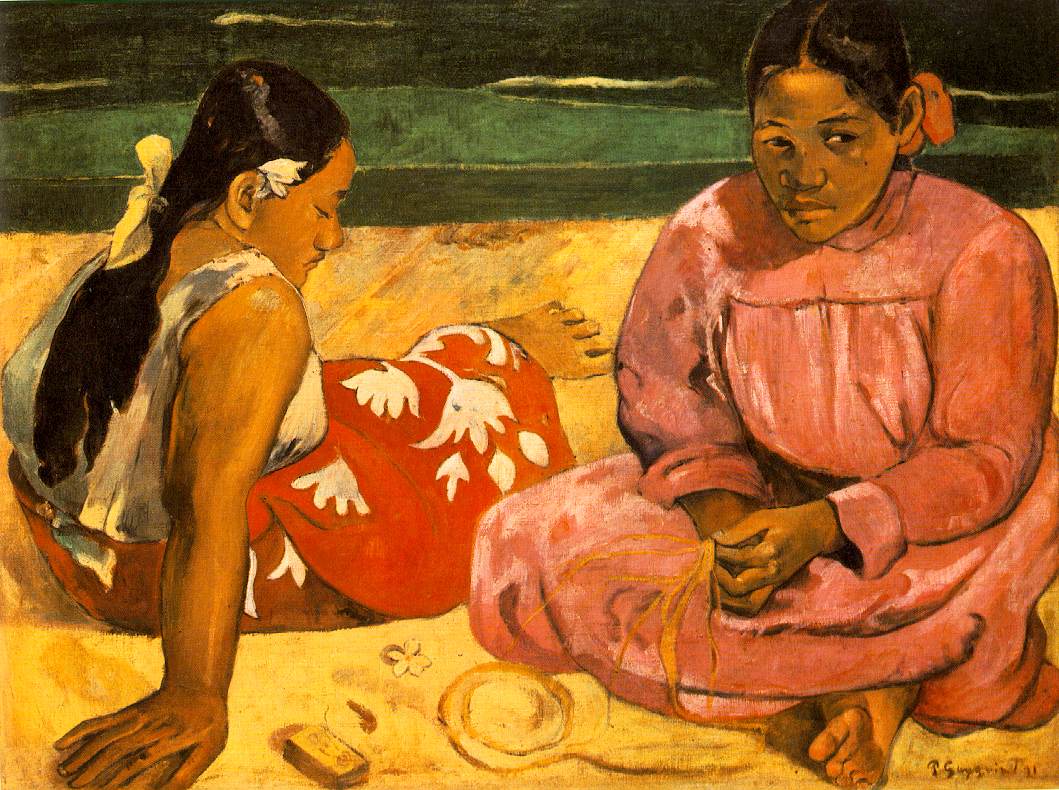
Femmes de Tahiti by Paul Gaugin


This is a painting by the Post-Impressionist Paul Gaugin. It is of two Tahitian women on a beach. Paul Gaugin was a painter who was once the head of the Postimpressionistic movement in France, but the movement of Postimpressionism was unpopular with the bourgeois and he decided to go Tahiti. Paul considered the land a place of unspoiled beauty and he painted a series of paintings there. This is an excellent example of how the New Imperialism effected life. Before the western powers felt the urge to conquer and explore the globe, places like Tahiti were far off the beaten track and hardly any Westerners had travelled to these places. They had not travelled there because there was no type of civilization that they were familiar with. France owned Tahiti in the very early 1900s and therefore Frenchmen, like Gaugin, could visit and explore the beauty of those foreign cultures. The source is reliable as it is a webmuseum of Paris and showcases many works by French and other painters.


This is a picture of the officers of the Rattrays Sikh. Rattrays refers to soldiers and Sikh is a religion which is mostly centered in the Punjab region of India. These were the officers who led a battalion commissioned by the British Indian government to police an area in the Lower Providences of Bengal that was currently revolting. The battalion is still very much in existence today and serves the Indian government. This picture depicts the members in their dress uniform, which in and of itself is an example of the New Imperialism. Britain conquered India and made it a colony called the British Raj (governing power of India or the actual name of the British occupied country). Life in India was radically changed with new British ideas flowing into the country. Efforts to modernize, throw off former systems of government, and embrace new technologies dominated how Indians thought. India as a country started to get nationalistic thoughts during this British occupation and eventually led to Gandhi and the formation of modern India. On the flip side, Britain gained many things Indian from their occupation. Britain received more exposure to tea (such a characteristic of British culture today!), curry, spices, cotton, and silk. The British Empire loved its Indian providence for its natural resources and human manpower, and trade between the two nations led to globalization for the entire region of southeast Asia. the source is from a site about the regiment's history and has many pictures of the regiment through its long existence.

This is a picture of Winston Churchill examining a Lee-Enfield rifle.

The artifact I have chosen is the famous Lee-Enfield rifle. The gun was developed in 1888 and is considered to be one of the most famous guns ever made. The Enfield was an incredibly reliable gun and the British army used it during both World Wars and prior to those engagements. The gun uses a "cock-on-closing" bolt and has the capacity for ten rounds in its magazine. The gun had quick firing capabilities and a fairly large magazine compared to muzzle loader or single shot breech firing gun of the time. The British certainly took advantage of superior weaponry at the time with all of its army's soldiers carrying this gun. The New Imperialism was directly impacted by developments of weaponry, like the Lee-Enfield rifle since this allowed the British to take advantage of superior weaponry. No native would have access to high technology like a multiple round firing weapon. This gun helped the normal foot soldier fight his way to British power. powerful weapons like the Maxim gun were also developed but they helped regiments as a whole and not the individual foot soldier. To a normal man, a better gun could be a godsend in many a dire situations. The gun also stood the test of time and was so advanced for the 1880s that it stayed in use by the British military until 1957. The picture is from the show "How Stuff Works" and the information from a website of Lee-Enfield enthusiasts.


Monday, May 10, 2010

I Become More Knowledgeable About the World


Current Events

One issue I learned about this year was the problems of the Lord's Revolutionary Army located in Uganda and Sudan. The situation there is not a pleasant one, especially to the ears of a first world country like the USA where we enjoy many benefits of modern society. The LRA was established by a man named Joseph Kony. Kony leads the movement and believes he is a good Christian and his movement is just. The LRA is far from a noble cause. Figures say that between 20,000 and 30,000 children have been abducted by this army to be used as child warriors or even sex slaves.The threat of abduction has lead to many, many people being displaced and children are forced to even flee to hospitals every night to hide. The LRA has troubled the entire region in Uganda and torments the inhabitants with their fighting and needless bloodshed. Currently Kony is still on the run. The New York Times recently gave information stating that the Ugandan army was using former child soldiers to hunt down their former tormentor. Hopefully, this new strategy will bring Kony to justice and pay for the countless amounts of people who have had their lives ruined by his actions.


The Haber-Bosch Process

History of the 20th Century


The 20th century started out with a slew of new inventions and the world became even more deeply rooted in industry. Inventions such as the airplane, car, and more importantly to our health, the development of the Haber-Bosch ammonia synthesis process. This process shaped the way to allow for more fertilizers that would feed our growing world into the first world war and the following one. After WWI self-determination would create the desire for groups of people to create their own countries and nations. This concept obviously impacts our world today, look at a map of Africa with its many nations. Three types of government; democracy, communism, and fascism all vied for power in postwar Europe. The Great Depression created turmoil on the industrialized world and there was a great sense of uncertainty. Unfortunately, WWI led to a second world war, this one being just as deadly as the first. After the war, western Europeans lost power in places like Africa and with the thoughts of self-determination, many countries formed. Technology has rapidly advanced and allowed many things from incredible medicines to horrible nuclear weapons. Civil rights in the past 50 years have increased to allow universal suffrage in many countries and most countries are now trying to modernize after shaking off old world ties and attempts at communism. The United Nations is one example of a postwar organization that is helping bring the rest of the world to the same page as wealthy nations like the United States.


Racism has no basis in genetics.


Human Diversity


In this semester we learned about the term "Race." In actuality there are no races of people. genetically we are all the same and the concept of race is in and of itself, skewed. A common example of a characteristic which we identify as race is one's skin color. In actuality, there are no differences between a person with dark skin or light colored skin. The person with darker skin has merely spent more time out in the sun whereas the other, lighter, person has not. It has been genetically shown that we are all genetically 99.9% the same. The concept of race justified social inequalities as normal, natural things. That misconception of race has led to the problems of racism faced in the world today, when we all know that humans, are all simply, humans.


The Blue Hole, New Mexico


Places on the Earth


Certain areas of this earth are truly different than the rest of the world. Sure, every little acre of land is unique compared to the last, but some places defy the stretches of human imagination. Places like Mt. Everest, the Great Coral Reef, and the Victoria Falls change the human perspective on the wide world in which we live. These extremes of nature beg us to explore them, to conquer them. No greater example of this urge to conquer the wild is that of the Mt. Everest climbers. These brave men and women go against the hellish frozen conditions to scale the mountain to say they were on top of the world. Many die, and many lose limbs to the freezing cold winds and conditions. Everest is unique and so are all the mountains in the Himalayans. The Himalayans are ironic in their natural wonder and beauty but if ventured into by an unknowing soul, can seem very deadly. The south pole has also drawn the allure of many an adventurer. Roald Amundsen was the first person to reach it in1911. The poles are an example of one of Earth's extreme places that fascinates the human imagination to explore them. Many places on earth are not as well known, yet are equally beautiful and inspire the human urge to explore. Places like The Blue Hole in Santa Rosa, New Mexico and the lush dense trees of the southern Oregon tropical forests. The Earth is home to a whole slew of fascinating places and the more one travels the more one discovers them.


The world has many cultures

Cultures of the World's Societies


As I have come to realize, the cultures of the world are truly something to rejoice in. If all humans held the same series of beliefs and norms we would have a dull world. This year I have further increased my knowledge of the many peoples who inhabit this earth. I studied Somalia and learned of a people used to conflict but still keep their unique culture alive. this crosscoads of the world place lead to an example of how many cultures fuse into one beautiful mixture. The Somali have an African like climate and appearance, a middle eastern set of values/ religion, and even a mix of Indian and Southern Asia foods and spices. I have realized that each culture begs for my knowledge and intrigue.Through the course of the year, i have compared Scotland to India and how cultures are different but all boil down to one thing, the human element in the. Culture is a way of life for a group of people and instead of stereotyping one culture to every person in that society one can observe how a culture is fitted into one person's life. An example? Look at American and European regards to marriage. A couple must love one another and go through courtship, dating, etc... We accept this as a nor. In India or Afghanistan marriages are often arranged, not to say that this is wrong simply a way of life. American marriages have a high divorce rate but arranged marriages often do not. All in all, one can see that little cultural differences are what makes people and the world unique. Japan's concept of politeness and gentility is quite different than ours. To close one's eyes in Japan is to be thinking, not sleeping. Cultre is something to embrace and love, to explore and delve into. Culture is what makes us unique.


Tuesday, May 4, 2010

Uganda


The situation in Uganda is certainly improving. I find it inspiring that the Ugandan army is becoming stronger as of late. The Commander Makasi who was so brutal to others has now turned away from his former role and adpoted one that is determined to get the LRA's leader, Joseph Kony. The man is very sneeky, especially in the way in which he is know to avoid capture. Kony would walk backward or use otehr hiding tricks in the bush to stay alive. It is important for this man, who has captured many innocent children and abused so many rights, to be brought to justice. It is unfortunate that peaceful measures could not have been used, but as in many cases, people will not stop terrible evil just beacause it is told to them that it is wrong.

Thursday, April 22, 2010

Somalia


Somali Piracy

Piracy. Its the reason why us Somalians are known in the global community. Sure, we have a very unstable government and war is constant, but that is not why I am here today. As an international problems are conerned in Somalia, piracy is on the top of the list. Pirates in Somalia are men from a variety of former occupations but a main reason the piracy grew in Somalia was the fact that polution from other countries eroded the fish stock in the Somalian waters leading to bands of men comign to together to protect their fishing areas from poultion. Somalia has a very poor economy and when fishing is hurt and the country here is already very poor the only option is to prey on the rich vessels that come through the Red Sea. Piracy is a very attractive option to many men. The rewards are good, the guns and explosives are fun compared to herding, and close proximity to the rich vessels makes it easy to get to the goods. Our government has a very limited navy and we cannot do much. I ask you, my fellow delegates, we need international help to combat the menance of the seas that is coming from our country. India has already given aid my sending some destroyers into our country's waters. Russia has agreed lately to send another destroyer to protect the area. Our country's strategic location is one of the most busy straits in the world for shipping and if not protected more of these pirates will attack shipping. Effects on the global economy are not limited to hijacked ships which coast millions of dollars to ransom. Piracy scaries away legal fishermen and sponsors illegal fishing. Pirates took in the year 2008 took in over $150,000,000! Prisoners are often taken and ransomed off as well and obviously there are casualties. As the represenitive from Somalia I beseech you to send our country more naval help.

Friday, February 19, 2010

My Japanese Project


I intend to research Japanese edged weapons focusing on their history and how they were used in history by Samurai and Ninjas and the lot. My intended (imaginary) audience is people in the entertainment industry who want to accurately depict Japanese weapons and not make up fake, huge, and utterly ridiculous look weapons. Some topics will include the Katana and a true Ninja's arsenal.

Monday, February 15, 2010

Exploring the Extremes

The first human to ever reach the South Pole (geographic South pole, that is) was Roald Amundsen in 1911 on December the 14 th. The North Pole was supposed to have been first reached by Robert Peary on April 6, 1909, however this fact is still debated but much proof has been found that supports the claim. The Mt. Everest summit attempt in 1924 was led by the British. The man in charge was Charles G. Bruce. Three attempts were made and the third attempt made by a climber named Irving and fellow climber Mallory. These two men died on the Mountain and there is some disagreement about whether they were the first. The first documented summit was in 1953 by Sir Edmund Hilary and Tenzing Norgay. Why would people do this? the sense of adventure yearns in the soul. People like Sir Edmund are driven to push themselves and to explore the little corners of the world that were untouched by man. Man has a sense to explore the globe and I understand completely how these explorers felt, the urge to leave society and see the world. I love to travel and only wish I could have been born 100 years ago so places like Everest and even Africa were still wild and open for adventurers. A great adventure is worth risking one's life for, without danger it wouldn't be as exciting.

Saturday, February 6, 2010

More Than 100 Years Later, the World I Live In Still Displays the Impact of the New Imperialism


Today the world rocks with results of the massive movement known as the new Imperialsim. I believe the New Imperialsm was the first large scale globalization effort since the orginal explorers in the 1500s. Today's world in Africa, Asia, and even Latin America still feel how Europeans carved up these territories to suit their own needs and wants. Africa is a great example. Africa today still sees how the Africans are very poor and work very hard a their livings, but most do not receive what they earn (a worker in the Diamond mines of South Africa and Botswana certainly do not receive any of those diamonds). Imperialism brought thoughts of democracy and nationalism to places where such concepts might never have been introduced. Populations have been conquered only to burst out as global powers again stronger than ever. Look at the Chinese, conquered by Britain and Japan and chopped to pieces by foreign powers looking for resources only to throw off those chains 100 years later and emerge as a modern, powerful country. The New Imperialistic Age brought technologies around the globe and increased knowledge of its peoples. Countries today in certain parts of the world still do things as they have been influenced by those European countries that conquered them, but through that national identity for those people has been formed. All in all, the current worlds countries have all been in some way, shape, or form been influenced by this New Imperialistic Age.

Positive Effects of the New Imperialism


The positives for conquering most of the free world were great for the conquerors (surprise, surprise!) and not as great for those people who were conquered. To start out, those who were conquered did gain some good benefits. More often than not, Europeans would westernize areas they conquered and thus would change traditional practices (including the very touchy one, religion) to what they deemed as proper and civilized. some examples of bad traditional practices that were changed due to westernization included, (in India) the practice of burning the wife of a widower with her husband and other persecutions to other people that changed when both parties were conquered by a third. Often in conquered places positive modernization effects would take place such as legal systems being revised; shipyards, mines, and factories being constructed; native people could get higher educations abroad in European schools; and, natives gaining access to new and exciting foreign technologies and (sometimes) luxuries. Now to the other side of the spectrum, the European elite gained an incredible amount of wealth, power, and land during the New Imperialistic age. Europeans like King Leopold II of Belgian gained private land abroad, labor to work it, and wealth from the natural resources he gained there. Europeans saw increases in labor and in their armies since conquered people would turn around and fight for the conqueror's army (its just another job). Europe also received a different sort of wealth, the wealth of knowledge of the world's geography, people, religions, philosophies, attitudes, ways of economy, and just general knowledge that being a globalized country brings. If one travels the world one inevitably learns more, I believe the greatest benefit of the New Imperialism for Europe and for indigenous populations was not gold, silver, or land. It was the knowledge of the multitudes of people that inhabit this Earth. every step into the unknown brought back another ten steps of insight and understanding.

Negative Effects of the New Imperialism


Negative effects of Imperialism were pertinent on both the European side of the spectrum and the side of the indigenous people of those areas they conquered. First, from the native inhabitants side. Places like India and China encountered a massive confusion in what they should believe in. To clarify, Indians were torn between modernizing and sticking to old traditional practices. Good leaders, like Ram Mohun Roy attempted to mix Western ideals and traditional values to have a unique cultural identity. Unfortunately this was easier said then done. India (along with other countries) faced the effect that Imperialism brought a whole new set of foreign problems to their already confused and troubled nations. The reason why the Europeans could conquer so much was helped by the fact most nations were in decline. The conquered people were often not consulted in matters pertaining to their own countries. Africans were never asked about how they would want Africa divided up. conquered countries often had their economic markets damaged by foreign goods and some imported more than exported causing a trade defect. Another obviousus negative effect on native peoples sides was the fact that whenever foreigners came in there was going to be physical war sometime or another since it is not easy to simply take over a country and everyone be happy. In India Seopys revolted mostly for the reason that they had to bite animal fat (against religious beliefs). So, whenever imperialism took place the indigenous population would suffer in war since their weapons were weaker than strong European guns. Europeans felt negative effects too, but to a much lesser degree than the native populace of the conquered lands. Europeans too had arguments over what was happening around the world. Some felt the rich were exploiting them or the government was somehow manipulating others. Europeans also suffered human lose whenever fighting occurred abroad. I believe the "little people" of Europe (like the peasants) did not gain too much from the imperialism of others since they were too poor to gain any foreign luxuries or the sort. The average Joe in Europe would probably end up paying more taxes to fund all this global expansion which I'm quite sure he did not enjoy doing.

What was the "New Imperialism?"

The "New Imperialism" was the rapid expansion of European powers around the globe in their efforts to dominate the peoples, economies, religions, and governments of those areas they conquered. This global rush for land in Africa, the Middle east, and Asia was led by great Britain who built an empire so large the sun would never set on land claimed to be part of Her Majesty the Queen's land. France, Germany, Russia, and to a lesser degree the United States would all join in the massive land grab that ensued in the 1880s due to many reasons. A large driving force for most countries was the economic factor. Britain, for example, needed natural resources such as manganese and iron for the countries massive steel mills in the North. Places like Africa were loaded with rich resources. The British (like other countries) desired also to create new markets to sell their goods (the British forced opium upon the Chinese and this led to The Opium War and years of strife). Political and military interests drew desire for imperialism since other countries saw the massive land grab as a chance to assert their dominance. Not all reasons for Imperialism were bad, missionaries and others often wanted to genuinely help those less fortunate. This was indeed a nobler cause for expansion. Unfortunately, the strong belief in Social Darwinism was the final factor in the rush for the world since Europeans assumed they were better than other races and European destruction of others was simply them helping the human species.

Thursday, January 7, 2010

I took the quiz with surpising results! I have been to 43 states and 5 differnt countries, and I assumed (not to sound negative) I would be able to distinguish people moderately well. I was proven wrong. I only got 5 people correctly sorted!! This goes to show that really we are all the same and just because we may look like someone from a differnt part of the world we are not nessacarily that "race." This quiz has shown me even more why I should believe in the idea that people are people first and should not be judged by their appearance. I have heard people say about falling in love with someone that it is not just the preety face or physical beauty, but the person's internal ways of thinking or feeling that atracts a person to another person. Al in all, an excellent lesson learned that "race" is not a good way to judge anyone.